Did you know that almost 90% of wild plants and 75% of leading global crops depend on animal pollination? Pollinators are, therefore, essential to our survival. These pollinators include the bumble, honey, and solitary bee species, which bring about pollination by transferring pollen from the flower’s anthers to the stigmas, and this way setting fruits and producing seeds. Worryingly, previous research, including that undertaken for the National Pollinator Strategy, has found that the number of bee species has fallen in multiple parts of the UK.
Dr Hauke Koch, research leader in Pollinator Biological Chemistry at Kew Gardens, stresses the dramatic change that is taking place in our landscape, with natural grasslands increasingly disappearing, and therefore affecting pollination in the UK.
“I’m doing a project this year on meadows and roadside verges trying to look at resources that pollinators get from meadows and it just really came to my realisation how dramatic the change in our landscape really has been.”
He continued: “97% of semi-natural grasslands in the UK have disappeared. And I think the major issue that pollinators face today is that they’ve lost a lot of the plant abundance and diversity that they need to feed on.”
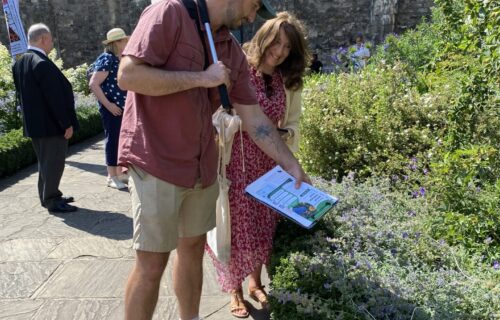
Pollinating London Together (PLT) actively addresses the threat of declining pollinator habitats through its City garden audit activities. Audits of green spaces have been undertaken to assess the ‘pollinator friendliness’ of the planting, the use of pesticides, and to understand if anyone is actively monitoring the activities of the pollinators. Guidance is then given to suggest any potential improvements that could be made to ensure the pollinators have a large enough food supply, as well as conditions suited to their ongoing health. Pollinator-friendly habitats can help their defence against common diseases.
Having started its garden auditing programme in 2020, PLT has now been able to perform a second round of audits to assess change. Results from the Goldsmiths’ Company garden and St Vedast-alias-Foster church have been very positive.
Richard Mucker, representative of Goldsmiths’ Company garden in the City of London, and his colleague David Arkin are particularly focused on increasing the number and type of pollinators. Mucker tells us that the plan of increasing pollination in Goldsmiths’ garden has been working well so far:“The second audit was a couple of months ago. Luckily, it was an improvement on our first audit, which proves that the work David has been doing and the advice we’ve had from Pollinating London Together about which plants are best is working. So that’s good. We have a bee house now in the garden, so we’re looking forward to seeing how that develops over the next few years.”
Similarly, Paul Kennedy, the priest in charge at London’s St Vedast-alias-Foster church, and his wife Paula Kennedy, have also been working to help reverse the decline of pollinator populations in London by planting a variety of herbs and flowers within the church’s courtyard.
“We were really grateful for the pollinator audit because it gave us some really good advice about things that we could plan to draw in bees and other pollinators. One of the big successes we’ve had is lavender; that’s gone down really well, and that’s been really busy this summer. I’ve noticed a massive difference. We’re planting out different types of herbs that will attract pollinators.”
PLT’s garden audits are a good example of how the first step towards positive change is often knowing what is currently happening through data collection. You can be part of this change too in your own gardens and contribute to a UK-wide citizen science project using technology on your phone. Learn more about the about citizen science for pollinators and the Flower-Insect Timed (FIT) app by visiting the PLT website.
By Gabriela Jimenez