When people think of bees, they often picture honeybees living in hives. But most bee species in the UK live very different lives. In fact, the vast majority are solitary bees, species in which each female builds and provisions her own nest, rather than living in a colony with workers and a queen. The UK is home to over 250 species of wild bee, and more than 220 of these are solitary bees. They come in a wide range of shapes, colours and lifestyles, with many species sporting features that make them surprisingly easy to recognise once you know what to look for.
One of the most familiar is the hairy-footed flower bee (Anthophora plumipes). Common in gardens, parks and urban areas, this fast-flying bee is one of the first solitary bees to emerge in spring. Males often appear first, zooming around flower beds and sunny walls in search of females. You can still spot both sexes well into spring in many places. The species gets its name from the male’s distinctive hairy middle legs. These hairs are thought to play a role in courtship and mating. Males are often seen patrolling patches of flowers, hovering as they wait for a chance to intercept a female. Hairy-footed flower bees are particularly fond of lungwort (Pulmonaria), an early-flowering garden plant with pink and blue flowers. This relationship is a great reminder that wild bees are essential pollinators not only of crops, but also of flowering plants in gardens, parks and the wider countryside.
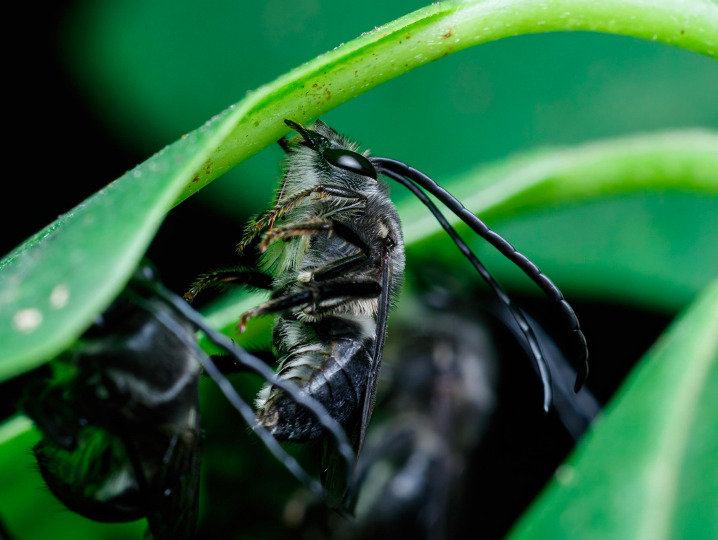
And their contribution matters enormously. Wild bees help pollinate many fruit and vegetable crops, supporting food production and the economy, while also maintaining healthy ecosystems by pollinating native plants that provide food and shelter for other wildlife. The hairy-footed flower bee is not the only unqiue looking solitary bee. The long-horned bee (Eucera longicornis) is famous for the male’s exceptionally long antennae, which can be longer than its body. The female pantaloon bee (Dasypoda hirtipes) has fluffy orange pollen-collecting hairs on her hind legs, giving the appearance of oversized furry trousers.
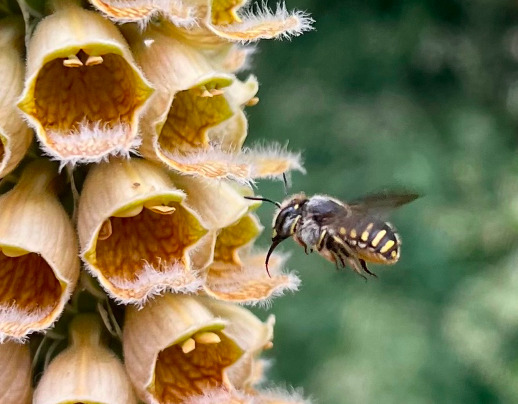
Then there is the wool carder bee (Anthidium manicatum). In this species, males are larger than females, unusual among bees. The males also have spines at the tip of the abdomen, which they use to drive away rival insects from prized flower patches. This is a very territorial bee species! Females collect soft fibres from plants such as lamb’s ear to line their nest cells, hence the name “wool carder”.
If you’d like to help solitary bees in your own green space, the best approach is simple: provide flowers and nesting habitat. Aim for a variety of bee-friendly plants flowering from early spring through to autumn, especially native species where possible. Hairy-footed flower bees often nest in soil banks or steep bare slopes, while wool carder bees use existing cavities and holes, sometimes in surprisingly small places, even gaps in wooden benches. With the right habitat, these fascinating insects may soon make themselves at home in your garden. Keep an eye out once you start noticing solitary bees, you may never look at flowers the same way again.