

Valuing the Importance of Urban Green Spaces
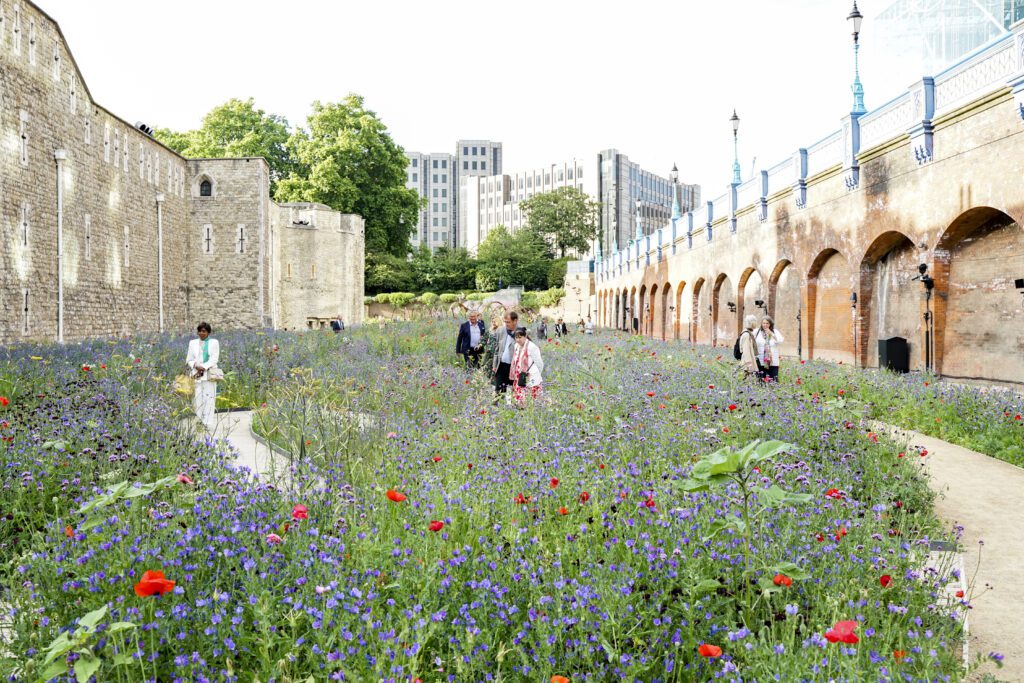
Enhancing green spaces in London where all natural pollinators can thrive, and their habitats can be enjoyed by all.
Valuing the Importance of Urban Green Spaces
Why Green Spaces Matter for Climate, Biodiversity and Health
Cities face two interconnected global emergencies: climate change and biodiversity loss. Urban green spaces are one of the few interventions that can address both simultaneously – while also delivering measurable benefits for human health and wellbeing. Understanding the full range of these benefits is essential for making the case for green space investment to decision-makers, developers and funders.
Green Plants and Climate Change Mitigation
Through photosynthesis, green plants absorb carbon dioxide and convert it into biomass, making them effective carbon sinks and long-term carbon storage systems. Mature trees store significant carbon in their woody tissue, and this storage continues to accumulate as the tree grows. Even when trees die naturally, gradual decomposition releases carbon slowly over many decades rather than all at once – and standing deadwood in particular supports extraordinary biodiversity while that slow release occurs, providing habitat for hundreds of invertebrate species including many saproxylic (dead-wood dependent) beetles and their associated food webs.
Green Spaces and Climate Adaptation
Climate adaptation refers to how cities manage the consequences of climate change: rising temperatures, more intense storm events, flooding and urban heat island effects. Well-designed green spaces contribute on all fronts:
- Cooling air through transpiration – trees and plants release water vapour, reducing local temperatures significantly
- Providing shade that reduces surface and air temperatures
- Insulating buildings, reducing energy demand for cooling in summer and heating in winter
- Absorbing and slowing stormwater runoff, reducing pressure on drainage systems during heavy rainfall events
- Reducing the urban heat island effect, which can make city temperatures several degrees higher than surrounding rural areas
Green roofs and well-designed urban planting schemes are increasingly recognised as essential infrastructure for climate-resilient cities, not optional amenities.
Natural Capital and Ecosystem Services
Natural capital refers to the stock of natural assets – soils, air, water, vegetation and living organisms – that generate flows of benefit to people. These flows are termed ecosystem services and include:
- Air purification through absorption of particulates and pollutants
- Water regulation, including filtration and flood attenuation
- Carbon storage and sequestration
- Pollination of crops and wild plants
- Flood mitigation through soil absorption and green infrastructure
- Habitat provision for wildlife
Nature-based solutions – working with natural processes rather than against them – are increasingly recognised as more sustainable, more cost-effective and less energy-intensive than grey infrastructure alternatives. The economics of natural capital are increasingly well-documented, with frameworks such as TEEB (The Economics of Ecosystems and Biodiversity) and the Dasgupta Review providing formal analytical tools for valuing these services in policy and planning contexts.
Biodiversity and Ecological Stability
Biodiversity – the variety of species within an ecosystem – is not merely an aesthetic or ethical concern. It is the foundation of ecological stability. Diverse ecosystems are more resilient: when one species declines, others can partially compensate for its functions. Simplified ecosystems, by contrast, are fragile – vulnerable to collapse when a key species is lost or conditions change.
The 2019 IPBES (Intergovernmental Science-Policy Platform on Biodiversity and Ecosystem Services) Global Assessment found that approximately one million species – out of an estimated eight million species on Earth – are currently at risk of extinction, and that ecosystem health is deteriorating at an unprecedented rate. Urban design decisions influence whether cities contribute to this trajectory or become part of the solution.
Policy frameworks are increasingly reflecting this urgency. Biodiversity Net Gain (BNG) – mandatory for most developments in England since February 2024 – requires development projects to demonstrate a measurable improvement in biodiversity value. Local Nature Recovery Strategies (LNRSs), being developed across England under the Environment Act 2021, provide the spatial framework for targeting habitat creation and enhancement where it will have most impact. Urban green space decisions made today directly influence these outcomes.
Health and Wellbeing Benefits
The relationship between access to green space and human health is well-established across multiple research domains. Evidence consistently shows:
- Reduced stress and anxiety through contact with natural environments
- Lower blood pressure and cortisol levels associated with time spent in green spaces
- Improved concentration and cognitive performance, particularly in children
- Faster recovery from illness and surgery in patients with views of or access to nature — a finding from clinical settings first documented by Ulrich (1984) and subsequently replicated in multiple studies
- Improved mental health outcomes and reduced risk of depression
Two well-established theoretical frameworks explain these effects. Attention Restoration Theory (Kaplan & Kaplan) proposes that natural environments restore directed attention capacity by providing effortless fascination that allows the prefrontal cortex to recover from fatigue. Stress Recovery Theory (Ulrich) proposes a distinct psychophysiological pathway: natural stimuli trigger an involuntary shift toward positive affect and reduced physiological arousal. Both mechanisms are supported by substantial empirical evidence and are complementary rather than competing.
Designing Biodiversity-Rich Green Spaces
For those influencing green space design, the following principles reflect current best evidence:
- Reduce hardstanding – replace paving and close-cut grass with planting where possible. Even small reductions in impermeable surface create planting opportunities and improve drainage.
- Avoid pesticides – minimise all chemical inputs, including herbicides that remove wild food plants as well as insecticides that directly harm pollinators.
- Provide seasonal forage – aim for continuous flowering from February through to November, with as much species diversity as space allows. Prioritise the under-served periods at the very start and end of the season. The goal is diversity and continuity, not a minimum count of species.
- Support wild pollinators – avoid introducing excessive managed honeybee colonies in areas with limited floral resources. Habitat creation benefits a far wider range of species.
- Create habitat variety – include sun and shade, dense hedging, textured foliage, standing dead wood and water sources. Structural diversity supports a much wider range of species than planting alone.
- Choose suitable plants – select species adapted to local conditions to reduce irrigation needs, maintenance costs and establishment failure.
Key Takeaways
- Urban green spaces mitigate climate change through carbon storage and reduce its impacts through cooling and flood attenuation
- Biodiversity underpins ecological stability – diverse ecosystems are more resilient to change
- Nature-based solutions support flood management more sustainably than grey infrastructure alone
- Urban planting decisions directly influence pollinator survival and the wider food web
- Green spaces deliver measurable, evidence-based improvements in human health and wellbeing
Urban green spaces are not decorative extras. They are essential infrastructure for climate resilience, biodiversity recovery and public health.