

Strategic Habitat Management Guide for Land Managers
Enhancing green spaces in London where all natural pollinators can thrive, and their habitats can be enjoyed by all.
Strategic Habitat Management Guide for Land Managers
Overview
Land managers, planners and organisations with responsibility for significant areas of urban or peri-urban land can make some of the most substantial contributions to urban biodiversity. Strategic habitat design – combined with consistent, evidence-based management – can dramatically increase pollinator populations and the wider biodiversity that depends on them. This guide sets out the principles, practices and monitoring approaches appropriate for professional land management contexts.
High-Impact Strategies
The following approaches consistently produce the largest gains in pollinator diversity and abundance on managed land:
- Convert amenity grass to wildflower zones – this single change typically produces the most significant biodiversity gain on managed sites. Success depends entirely on correct soil preparation (reducing fertility) and appropriate seed mix selection for site conditions.
- Create habitat corridors and stepping-stone networks – map the site in relation to surrounding green infrastructure and identify where new planting or management change would most improve connectivity. A corridor of limited ecological quality may be more valuable than a small area of high-quality habitat if it closes a critical gap in the network.
- Introduce rotational mowing schedules – divide managed areas into zones and cut them at different times throughout the season. This ensures that at any given moment, some areas are in flower and some areas provide refuge for invertebrates displaced by cutting elsewhere. The principle is that no single cutting event should eliminate all foraging or shelter simultaneously.
- Use native species planting plans informed by local ecological conditions – match species to soil type, drainage, light levels and the target pollinator community. Sites adjacent to existing high-quality habitats benefit from planting species that complement the surrounding flora.
- Reduce and ultimately eliminate chemical use – particularly systemic insecticides and herbicides. Where weed control is necessary, mechanical methods (cutting, scarifying) are preferable on sites managed for biodiversity.
Landscape Planning Principles
- Prioritise connectivity: assess every management decision in terms of its contribution to habitat linkage across the wider landscape, not just the site in isolation
- Design for seasonal forage: map the site’s current flowering calendar and identify gaps. Early spring (February–April) and late autumn (October–November) are the periods most often underserved and where targeted planting has greatest impact.
- Include structural diversity: aim for a gradient from short managed sward through tall grassland, scrub and, where space allows, woodland edge. Each structural layer supports a distinct suite of species.
- Protect nesting sites: identify and map ground-nesting areas, cavity nest sites and overwintering habitat. Buffer these from disturbance during sensitive periods (typically March–August for most bee species).
- Monitor ecological outcomes: management without monitoring is guesswork. Establishing baseline data and tracking change over time is essential for adaptive management and for demonstrating impact to funders and stakeholders.
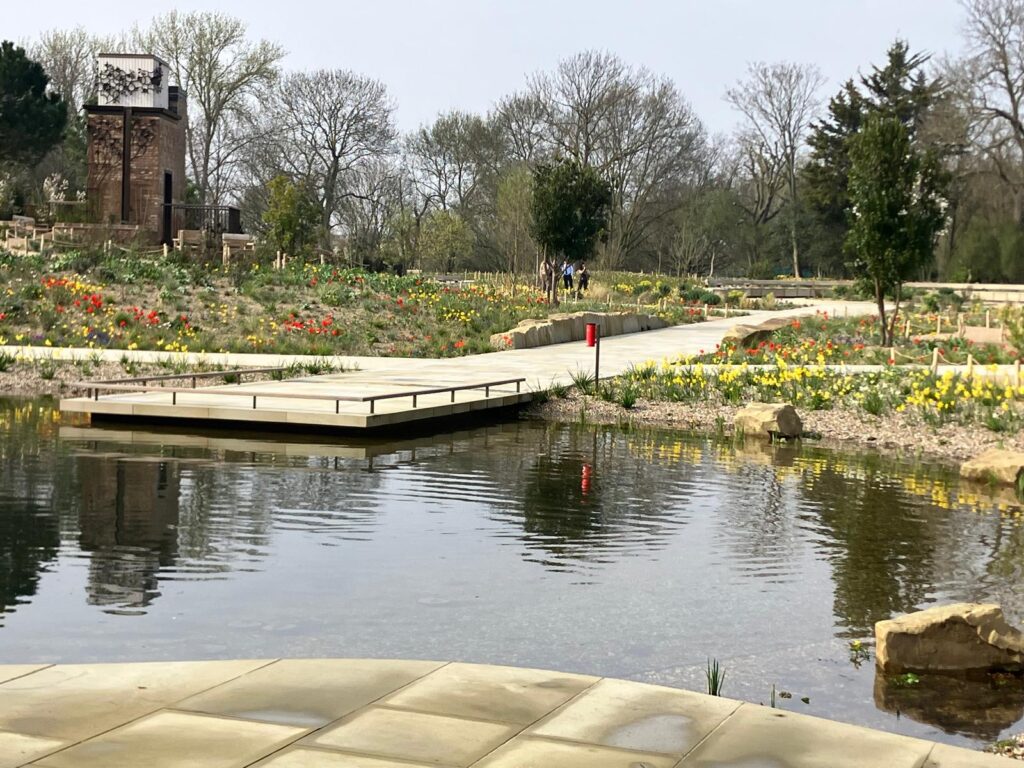
Meadow Management Best Practice
Wildflower meadow management requires consistent application of the correct regime to maintain low-fertility conditions and prevent rank grass from dominating. Key principles:
- Cut once or twice annually depending on the seed mix and management objective. A single cut in August–September suits most UK native wildflower mixes. A July cut is recommended where yellow rattle is present, as it sets seed early. A two-cut regime (June and September) can work for some sites, particularly where greater grass control is needed in establishment years.
- Always remove cuttings promptly after cutting. Leaving arisings on the sward returns nutrients to the soil, gradually increasing fertility and allowing vigorous grasses to outcompete wildflowers. This is the most commonly made management error on newly established meadows.
- Leave refuge areas uncut each year – retain 10–20% of the meadow area as an uncut refuge, rotating its position annually. This provides overwintering habitat for invertebrates and continuity of flower for late-season pollinators.
- Maintain habitat variety across the site – include areas of short sward, tall grassland and scrub alongside the meadow to support the full range of species that use grassland habitats.
- Scarify rather than fertilise: where bare patches develop, light scarification allows new seeds to establish. Never apply fertiliser to a meadow or wildflower area.
Monitoring and Evaluation
Robust monitoring is what distinguishes strategic habitat management from ad hoc planting. A good monitoring programme provides baseline data, tracks change over time, informs management decisions and enables credible reporting to stakeholders and funders. The following established methodologies are relevant to urban land managers:
- UK Pollinator Monitoring Scheme (PoMS) – standardised flower-insect timed counts (FIT Counts) and broader pollinator transect surveys. Free to join, provides data directly to the national monitoring programme, and generates a credible record of site pollinator activity over time.
- National Plant Monitoring Scheme (NPMS) – systematic recording of plant communities, useful for tracking vegetation change in response to management.
- Butterfly transect surveys following the UK Butterfly Monitoring Scheme (UKBMS) protocol – butterflies are useful indicator species and their monitoring is well-established and straightforward to implement.
- Moth trapping – a standardised light trap programme provides data on nocturnal pollinator diversity and population trends that daytime surveys miss entirely.
- Local Environmental Records Centres (LERCs) – submitting records to your local LERC contributes to the regional biodiversity database and can inform planning decisions affecting adjacent sites.
At the site level, track the following metrics annually:
- Species richness of flowering plants
- Flower density and seasonal coverage (number of weeks with open flowers)
- Pollinator visit rates using standardised FIT Count methodology
- Habitat coverage by type (meadow, scrub, bare ground, managed grass, tree canopy)
- Presence and distribution of key target species or species groups
Policy Context for Land Managers
Land managers operating in England should be aware of the following policy frameworks that directly affect habitat management decisions:
- Biodiversity Net Gain (BNG): mandatory for most developments in England since February 2024 under Schedule 7A of the Town and Country Planning Act 1990 (as amended by the Environment Act 2021). Developments must demonstrate a minimum 10% net gain in biodiversity value using the Defra biodiversity metric. Land managers can potentially generate BNG units through habitat creation and enhancement on their sites, creating a revenue stream while improving ecological value.
- Local Nature Recovery Strategies (LNRSs): being developed across England under the Environment Act 2021. LNRSs identify priority areas for nature recovery and the actions needed to achieve them. Land managers whose sites fall within or adjacent to LNRS priority areas may be able to access funding or partnership opportunities linked to the strategy.
- Environmental Land Management schemes (ELMs): for rural and peri-urban land managers, Sustainable Farming Incentive (SFI), Countryside Stewardship and Landscape Recovery payments are available for habitat creation and management actions including wildflower establishment, hedgerow management and reduced pesticide use.
- BREEAM and biodiversity in planning: for commercial development, BREEAM (Building Research Establishment Environmental Assessment Method) credits for land use and ecology and planning conditions requiring ecological management plans are increasingly standard. Robust monitoring data from existing sites strengthens applications and demonstrates management competence.
Key Principle
Consistent, long-term management produces far greater biodiversity gains than one-time planting projects. A site that is planted and then returned to standard maintenance within two years will revert quickly. A site that is planted and managed appropriately for five or more years will continue to increase in ecological value, support more species, and serve as a source population for surrounding habitats. The investment is in the management regime, not just the initial intervention.