

Monitoring Urban Pollinators in London
Enhancing green spaces in London where all natural pollinators can thrive, and their habitats can be enjoyed by all.
Monitoring Urban Pollinators in London
How Healthy Are London's Pollinators?
Pollinators are essential to healthy ecosystems and food production. But how are they actually doing in London? Pollinating London Together conducts ongoing monitoring surveys to understand which pollinator species are present in urban green spaces, and in what proportions. This work helps assess whether city habitats are supporting a healthy and diverse pollinator community.
A healthy pollinator ecosystem is not dominated by one species. It includes a wide range of bees, hoverflies, butterflies, moths and beetles performing complementary ecological roles. Without reliable data, collected consistently over time, it is impossible to understand whether urban biodiversity is thriving or declining – or whether conservation interventions are producing measurable results.
How We Measure Pollinators
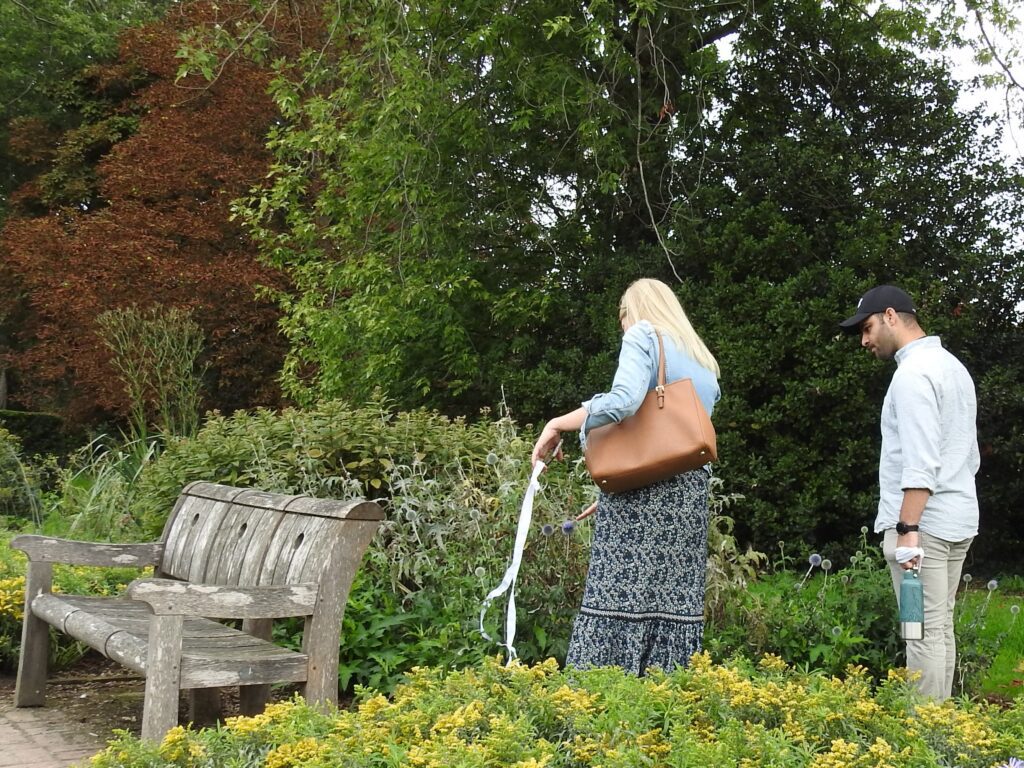
PLT primarily uses flower-visitor transect surveys, a standard and widely used ecological monitoring method. In this approach, surveyors walk a fixed route through a green space and record all insects observed actively visiting flowers within a defined observation zone, maintaining a consistent pace throughout. Only insects actively interacting with flowers are counted — pollinators simply flying past are excluded — ensuring that the data reflects real pollination activity rather than general insect presence.
Surveys are repeated along the same routes over time, making the data directly comparable across seasons and years. This repeatability is what makes transect surveys so valuable for long-term trend analysis: it is not possible to determine whether a population is stable, increasing or declining from a single snapshot.
It is worth noting that flower-visitor transects are one tool among several used in professional pollinator monitoring. Pan traps, netting surveys and timed species searches can capture species that do not readily visit the flowers present on a given transect route. PLT’s transect methodology is appropriate for tracking pollination activity and community composition at survey sites, and results are interpreted in that context.
Where We Conduct Surveys
London contains many different habitat types, and our monitoring is designed to reflect this diversity. Survey sites include urban parks, churchyards and burial grounds, rooftop gardens, private wildlife gardens and managed green spaces. Most monitoring takes place within the City of London and surrounding areas, enabling us to compare results across different urban habitat types and management regimes.
When Surveys Take Place
Pollinators are active only during certain seasons, and many species have very short adult lifespans. To capture the full seasonal range of species, surveys are conducted in multiple rounds, with each site visited once per round. Monitoring runs from spring through to autumn to ensure that both early-season and late-season species are included.
Late-season monitoring is particularly important. Species such as the ivy bee (Colletes hederae) – one of the most notable recent colonisers of London — are active almost exclusively in September and October when ivy is in flower, and would be missed entirely by a monitoring programme that ended in late summer. Autumn surveys also capture late-flying bumblebee workers and queens, hoverflies and butterflies that are active well into October in mild years.
What the Data Shows So Far
Long-term monitoring is essential because pollinator populations change slowly and habitat interventions may take several years to show measurable results. Building a reliable baseline is the first requirement before any trend analysis becomes possible.
One consistent finding to date is the dominance of honeybees at many urban sites. This matters for several reasons. Honeybees can forage up to several kilometres from their hive, with most foraging activity taking place within 1–3km – a considerably larger range than most solitary bee species, which typically forage within a few hundred metres of their nest, with larger species ranging up to around 500–600m. In areas with high managed hive densities, this asymmetry means that honeybees can place significant competitive pressure on wild pollinators across a much larger area than the hive’s immediate surroundings.
Additionally, pathogens including viruses such as deformed wing virus (DWV) and fungal spores such as Nosema ceranae – which are associated with managed honeybee colonies – can be deposited on flowers and subsequently picked up by visiting wild bees. The evidence for this transmission route is growing, though the scale of its impact in specifically urban settings continues to be investigated.
Unlike wild pollinators, honeybees are actively managed by beekeepers and are not experiencing the same pressures of habitat loss and forage scarcity that drive wild bee declines. Monitoring helps ensure that urban planting and land management decisions support biodiversity as a whole rather than unintentionally increasing competitive pressure on the species most in need.
Reasons for Optimism
Despite the challenges facing urban pollinators, London’s green spaces continue to support remarkable species — including some that require quite specific habitat conditions to survive. Recent survey findings illustrate how even small, well-managed habitat features can provide critical nesting and foraging opportunities.
At Bunhill Fields Burial Ground, surveyors recorded what appears to be nesting activity by violet carpenter bees (Xylocopa violacea) in standing dead wood. The violet carpenter bee – the UK’s largest bee species, with a wingspan of up to 40mm – has been establishing breeding populations in London in recent years following range expansion from continental Europe. Its presence at Bunhill Fields, and its use of standing dead wood as nesting habitat, underlines the importance of retaining structural features such as deadwood in managed urban green spaces.
At Christchurch Greyfriars, wool carder bees (Anthidium manicatum) have been recorded in the vicinity of wooden benches. Wool carder bees are solitary bees that nest in pre-existing cavities – such as hollow stems, gaps in soft mortar or bee hotel tubes – lining their nest cells with plant fibres carded from hairy-leaved plants such as lamb’s ear (Stachys byzantina). Males are highly territorial and are a conspicuous presence wherever suitable nesting and foraging habitat exists. Their presence at Christchurch Greyfriars is a positive indication of habitat quality at this site.
Why Monitoring Matters
Long-term ecological monitoring is the foundation of evidence-based conservation. Without consistent data collected over multiple years, it is impossible to distinguish genuine population trends from natural year-to-year variation, or to demonstrate whether habitat interventions are producing results. PLT’s monitoring programme enables:
- Evidence-based habitat design, grounded in what is actually present at each site rather than assumptions about what should be there
- Better planting decisions, informed by which species are underrepresented and what resources are missing from the current flora
- Informed urban planning, with data that can be used to influence green space management decisions by councils and landowners
- Measurable biodiversity outcomes that can be reported to funders, stakeholders and the public
- Improved policy guidance at local and regional level
PLT submits survey records to national and regional recording schemes, contributing to the wider evidence base on urban pollinator populations. Data submitted to platforms such as iRecord and shared with organisations including the Bees, Wasps and Ants Recording Society (BWARS) and the UK Pollinator Monitoring Scheme (PoMS) network means that PLT’s findings contribute to national trend analysis as well as informing local decision-making.
Impact Summary
- Ongoing flower-visitor transect surveys across multiple urban habitats in and around the City of London
- Multi-season monitoring from spring through autumn, capturing early, mid and late-season species
- Evidence of honeybee dominance at some sites, informing PLT’s position on managed hive density in urban areas
- Confirmed presence of specialist wild pollinator species at key sites, including violet carpenter bees and wool carder bees
- Data contributing to science-led urban biodiversity decisions at site, local authority and policy level