

Urban Planting Schemes by Habitat Type
Enhancing green spaces in London where all natural pollinators can thrive, and their habitats can be enjoyed by all.
Urban Planting Schemes by Habitat Type
Overview
Different urban spaces require fundamentally different planting approaches. Matching plant species to the actual conditions of a site – light levels, soil moisture, substrate depth, exposure – produces healthier plants, lower maintenance requirements and significantly better outcomes for pollinators. This guide outlines recommended species for the main habitat types found in urban environments.
Sunny, Dry Spaces
Examples: south-facing rooftops, exposed balconies, roadside verges, dry sandy soils
These conditions suit drought-tolerant, Mediterranean-origin and native calcareous grassland species. Many of the highest-value pollinator plants thrive in exactly these conditions.
- Lavender (Lavandula angustifolia)
- Sedum / ice plant (Hylotelephium spectabile) – exceptional late-season value
- Wild thyme (Thymus polytrichus) or garden thyme (Thymus vulgaris)
- Wild marjoram (Origanum vulgare) – one of the highest-value plants for bees and butterflies; choose the species rather than ornamental cultivars
- Common knapweed (Centaurea nigra)
- Field scabious (Knautia arvensis)
- Viper’s bugloss (Echium vulgare) – exceptional for bumblebees and solitary bees on dry, sandy or disturbed ground
- Bird’s-foot trefoil (Lotus corniculatus)
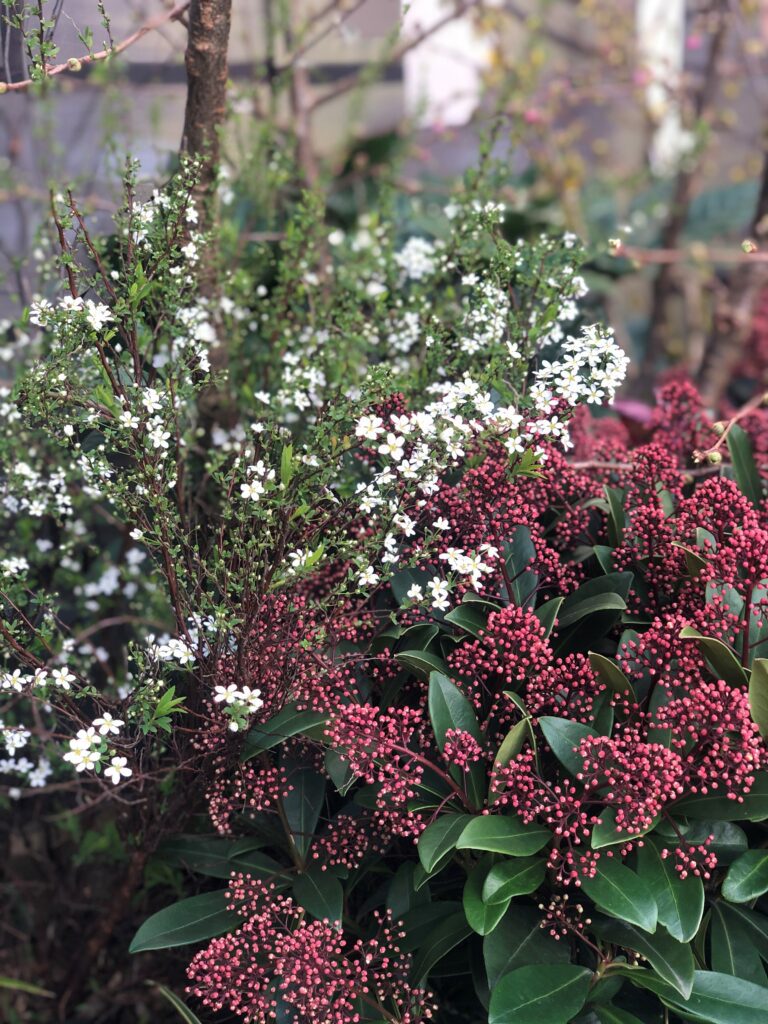
Shaded Areas
Examples: north-facing courtyards, alleyways, under tree canopy, buildings with limited sun exposure
Shade-tolerant pollinator plants are fewer in number than sun-lovers, making careful selection important. The following species are genuinely adapted to low-light conditions:
- Foxglove (Digitalis purpurea) – tolerates partial shade well; biennial, self-seeds freely if seed heads are left
- Lungwort (Pulmonaria species) – excellent early spring value in shade
- White deadnettle (Lamium album) – native, early-flowering and genuinely shade-tolerant; choose the species rather than ornamental Lamium maculatum cultivars, which are primarily grown as ground cover and vary in pollinator value
- Bugle (Ajuga reptans) – native, spreads well in shade, excellent for early bumblebees
- Wood avens (Geum urbanum) – common native of shaded and semi-shaded areas, good early pollen source
- Sweet cicely (Myrrhis odorata) – tall native umbellifer for dappled shade, attractive to a range of insects
- Ground ivy (Glechoma hederacea) – native, excellent ground cover in shade, valuable early nectar source
- Ivy (Hedera helix) – outstanding late-season nectar source that thrives in shade; allow it to reach its flowering adult form
Small Containers
Examples: window boxes, balcony planters, hanging baskets, rooftop containers
Container planting requires compact, relatively drought-tolerant species that provide good pollinator value without outgrowing their space. Use peat-free compost and ensure good drainage.
- Wild thyme (Thymus polytrichus) – low-growing, long-flowering, excellent for small bees
- Catmint (Nepeta x faassenii or Nepeta racemosa) – compact forms available, long season
- Lavender (Lavandula angustifolia) – choose compact varieties such as ‘Hidcote’ or ‘Munstead’
- Dwarf cornflower (Centaurea cyanus) – annual, easy from seed, highly attractive to bees
- Bird’s-foot trefoil (Lotus corniculatus) – compact, native, good for a range of species
- Cowslip (Primula veris) – excellent early spring value in containers
- Scabious (Scabiosa columbaria) – compact native scabious for summer through autumn
- Field pansy (Viola arvensis) – annual, suitable for containers, attractive to early bees
Large Green Spaces
Examples: parks, estates, school grounds, corporate campuses, hospital grounds
Large spaces offer the greatest opportunity for ecological impact. The priority is diversity of habitat types within the site, as well as connectivity to surrounding green infrastructure.
- Wildflower meadows – on low-fertility soils or after topsoil removal; include yellow rattle (Rhinanthus minor) where establishing into existing grass
- Mixed native perennial borders – combining grasses and flowering plants for structural diversity and year-round interest
- Native hedgerows – using species such as hawthorn (Crataegus monogyna), blackthorn (Prunus spinosa), field maple (Acer campestre) and dog rose (Rosa canina); hedgerows provide nesting habitat, food and connectivity
- Woodland edge planting – where space allows, a graduated transition from grassland through scrub to tree canopy supports the widest range of species
- Retention of structural features – log piles, standing deadwood, bare soil areas and undisturbed margins are as important as the planted areas
Moist Areas
Examples: rain gardens, pond and wetland margins, drainage swales, areas prone to seasonal waterlogging
Moisture-tolerant native plants for wet or seasonally wet conditions:
- Purple loosestrife (Lythrum salicaria) – native species, outstanding for a wide range of pollinators at pond and stream margins. Specify the native species rather than ornamental cultivars; note that Lythrum salicaria is considered invasive in North America if the site has international stakeholders.
- Meadowsweet (Filipendula ulmaria) – native wet meadow species, highly attractive to hoverflies and beetles; grows to 60–120cm so plan for height
- Marsh marigold (Caltha palustris) – native, one of the earliest wet-margin flowers, valuable for early spring pollinators
- Ragged robin (Silene flos-cuculi) – native wet meadow species, excellent for long-tongued bumblebees
- Water mint (Mentha aquatica) – native, spreads well at water margins, valuable late-season nectar source
- Hemp agrimony (Eupatorium cannabinum) – tall native of wet ground, exceptional for butterflies and hoverflies
Green Roofs
Examples: commercial and residential rooftops, podium decks, garage roofs, transport infrastructure
Green roofs are one of the fastest-growing urban habitat types and deserve distinct treatment in any planting guide aimed at planners and designers. The pollinator value of a green roof depends critically on its design — a standard extensive sedum monoculture has very different ecological value from a biodiverse green roof designed for wildlife.
- Extensive green roofs (shallow substrate, 80–150mm): primarily sedum-based, low weight, minimal maintenance. Ecologically limited but better than no vegetation. To increase pollinator value, introduce native wildflowers such as thyme, bird’s-foot trefoil, viper’s bugloss and common knapweed into the substrate mix.
- Semi-intensive and intensive green roofs (deeper substrate, 150–500mm+): support a much wider range of plants including wildflower meadow mixes, shrubs and small trees. These can function as genuine habitat patches and stepping stones in the pollinator network.
- Biodiverse or brown roofs: designed to mimic post-industrial or brownfield habitats, with varied substrate depths, rubble, bare substrate areas and diverse seed mixes. These are among the highest-value green roof types for urban wildlife and are particularly associated with invertebrate diversity.
Regardless of roof type, key design principles include: varied substrate depth to create microhabitat diversity; inclusion of native species; avoidance of systemic pesticide use; and, where possible, bare substrate areas to support ground-nesting invertebrates.
Design Principles
- Plant in clusters of three or more of the same species for maximum visibility and foraging efficiency
- Prioritise native species, which are co-evolved with local pollinators and typically support the broadest range of species
- Provide layered planting heights – low ground cover, mid-height flowering plants, shrubs and trees where space allows
- Avoid monocultures – diversity of plant species directly drives diversity of pollinator species
- Plan for seasonal continuity – ensure something is in flower in every month from February to November
- Specify open, single-flowered varieties – avoid double-flowered cultivars where nectar and pollen are inaccessible