Hero of the Month – April 2021

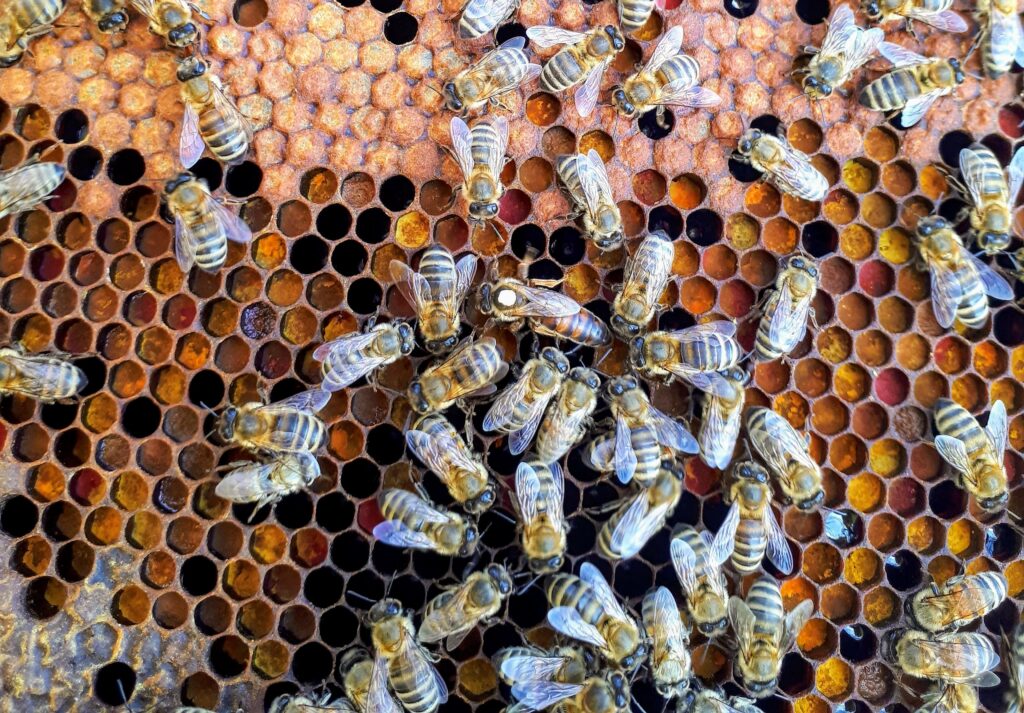
A Queen bee, marked by the white dot, surrounded by her workers, Photo by Boba Jaglicic on Unsplash
A Queen bee, marked by the white dot, surrounded by her workers, Photo by Boba Jaglicic Unsplash

The Honeybee Queen


Welcome to our first of the Pollinating London Together “Hero of the Month” blog posts by Tamzin Kerslake. Here, we will be giving updates, hints, tips, and some insider knowledge ready to transform you into practically perfect pollinators.

What better way to start off our program than focusing the spotlight on the ruler of the hive, “the monarchy of May”, the queen bee herself? The Honeybee Queen.

The Western Honeybee, Apis mellifera, consists of three main roles within a hive:

The male drones, the workers (all female), and the queen herself.

While hives, at their peak, can reach tens of thousands of bees, there is only one queen present in the honeybee hive. They can be distinguished from workers by their longer body and lack of a pollen basket on their hind legs.

This is different to the Schwarziana quadripunctata bee, a stingless bee species from South America. Ribeiro and Alves noted (ALVES & RIBERIO, 2001) that they can have multiple virgin queens in a hive ready in case a quick ascension is required.

Born This Way?

Theoretically, any female egg has the potential, at the point of fertilization, to become the queen bee. In fact, there are often several potential queen bee larvae in the hive at any point of new ascension. It all depends on the diet. All bee larvae relish on the same regal repast: royal jelly. This is a substance that looks like milky snot and consist of different sugars, lipids, vitamins and proteins to help the larvae grow – it is secreted from the heads of nurse bees. After three days, those not chosen as potential queens will switch to a diet of beebread: pollen, nectar, and honey. The eventual queen, however, will continue to eat royal jelly for the rest of their lives.

Royal Diet

Research into the royal jelly helps us to further understand the queen’s development. The study of epigenetics investigates how the environment can affect gene expression. The exclusive diet of royal jelly prompts the development of queen bees.

However, research by Mao and others (MAO, SCHULER & BERENBAUM, 2015) suggests that it is not the inclusion of the royal jelly that prompts the developmental changes that create a queen bee, but rather the exclusion of the pollen that otherwise castrates the other bees!

One Bee to Rule Them All

When a new queen is needed in the hive, there are multiple prospective queens developing as larvae. It is the first to hatch that becomes the queen. However, to ensure no one challenges this title, the queen then goes and stings the other prospective queens, killing them in their brood cell.

Mother of the Hive

Unlike what her title may suggest, a queen bee does not have any rule in how the hive functions. Her sole role is to provide offspring to populate the hive, and it’s a job to which she is very dedicated. A queen bee can lay up to 1,500 eggs in one day at the peak of her reproductive period. That’s more than her body weight in eggs!

A Busy Bee

A honeybee queen will start her role of repopulating the hive within the first 10 days of her adult life. She will, on average, mate 12-15 times with different drones during the mating flights at the start of her life, which is vital for ensuring the genetic diversity of a hive.

Making An Entrance

A queen will alert the potential mating drones of her presence with her smell! She releases pheromones, with the stronger the pheromone suggesting the stronger rate of fertility and reproduction. The male drones are first attracted to her scent and will use this to seek out their new potential queen.

A Different Type of Zoom Meeting

Whilst the queen bee will rarely leave the hive unless it is for a mating flight, within these flights she can fly a considerable distance to find the right drone. She can fly up to three miles away from her hive, and as a drone can do the same – she can therefore theoretically mate with a drone from a hive six miles away!
A honeybee worker flies on average three miles in a single trip, depending on forgeability, but can fly upwards of ten kilometers! In regard to mating purposes, this is vital for ensuring biodiversity in the hive. Photo by Dustin Humes on Unsplash

Keeping Reserves

A queen can keep fertilizing eggs for up to four years after mating with drones. She keeps sperm to fertilize eggs in both her oviducts and her spermatheca (SCHNEIDER, 2020). Worker bees create wax cells for a queen to lay eggs into. A queen chooses which eggs she fertilizes, with fertilized eggs growing to becoming workers, and unfertilized becoming drones.

Humble Servants or Bumble Slayers?

The worker bees will work hard to protect their queen. In fact, her food of ‘royal jelly’ is secreted from their heads. However, they are not above a revolution if they feel like their queen is not fit for reproductive purpose. As a queen ages, her pheromones decrease, as does her reproductive rate.

When the queen is deemed ‘un-fit’ for service, the workers will induce a new set of prospective queens and kill her off in the supersedure.

However, this is not always the end of the queen: the queen can go off before she is killed with a few loyal subjects and have her own hive elsewhere. Thus, the story of the hive can continue…

Find out more about all things bees, pollinators, and how we can play a part in protecting them with Pollinating London Together.

Share This Post