Spring is properly underway, and with it comes a surge of insect activity across London’s green spaces. While bees often steal the spotlight, there’s another group quietly doing important work at this time of year: flies.
What is a fly?
True flies belong to the order Diptera, that literally means “two wings.” Unlike bees, butterflies or dragonflies, true flies have just one functional pair of wings. Their second pair has evolved into tiny balancing organs called halteres, which act like stabilisers and allow for incredibly agile flight. If you’ve ever watched a fly hover mid-air, you’ve seen those halteres in action. Most flies also have large compound eyes and relatively short antennae. And importantly, many of them are active during the day.
What is a hoverfly?
Hoverflies (family Syrphidae) are a particularly charismatic group within the flies. As their name suggests, they’re capable of hovering in one spot, often pausing mid-air before darting between flowers. Unlike many other flies, hoverflies are usually smooth or softly hairy rather than bristly. They’re often brightly coloured too. Yellows, oranges and blacks are common, and many species, like Volucella zonaria, mimic bees or wasps. This mimicry can be surprisingly convincing, but hoverflies are completely harmless: they don’t sting. The hornet mimic hoverfly is the UK’s largest hoverfly. It closely resembles a hornet, but that’s just looks to scare off predators. Its larvae develop inside wasp nests, acting as a kind of clean-up crew by feeding on waste and dead material.
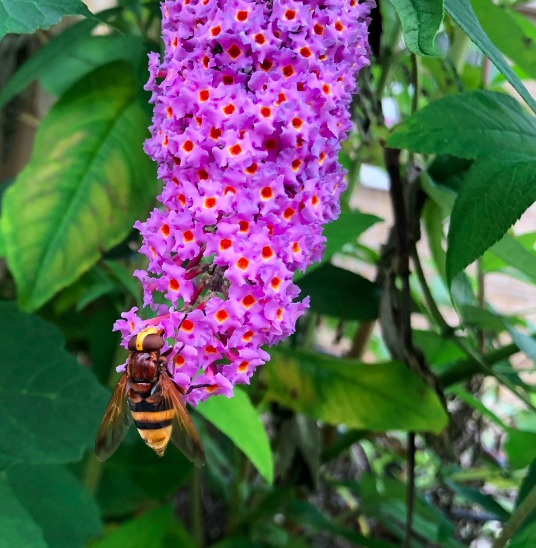
When looking for hoverflies, you’ll most often spot them when they are visiting flowers, though exactly which flowers depends on the species. Some prefer open, flat flowers, while others are adapted to deeper ones with longer mouthparts. A few species aren’t primarily interested in nectar at all, instead feeding on honeydew produced by aphids.
The UK hosts an impressive diversity of hoverflies, with around 280 species recorded.


Small Spot-Eye Hoverfly. This species is recognisable thanks to the distinctive spotted pattern on its eyes. We spotted this example on our recent rooftop mark and recapture experiment.
Batman Hoverfly, named for the bat-shaped marking on its thorax, this species lays its eggs in stagnant water. The larvae, known as rat-tailed maggots, use a snorkel-like tube to breathe while submerged.
Hoverflies pull double duty in our ecosystems. As adults, they are important pollinators of fruit trees, garden plants and wildflowers. In some cases, they can rival bees in the amount of pollen they move between flowers. But it’s their larvae that really make them a gardener’s friend. Many species have aphidophagous (aphid-eating) larvae, meaning they help control common garden pests naturally. A single larva can consume hundreds of aphids during its development.
Supporting hoverflies in your garden
The good news is that hoverflies don’t need anything particularly fancy. A mix of flowering plants with different shapes and flowering times will support a wide range of species. Leaving a small patch of standing water, maintaining some damp or decaying organic matter, and avoiding pesticides can all make a difference too. So next time you see a “bee” hovering effortlessly over your flowers, take a closer look, it might just be a fly doing some of the city’s most important pollination work.